

TheFeedLab
Press Y to Continue: AI’s Drinking Bird Problem
In November 1995, Homer Simpson solved remote work.1
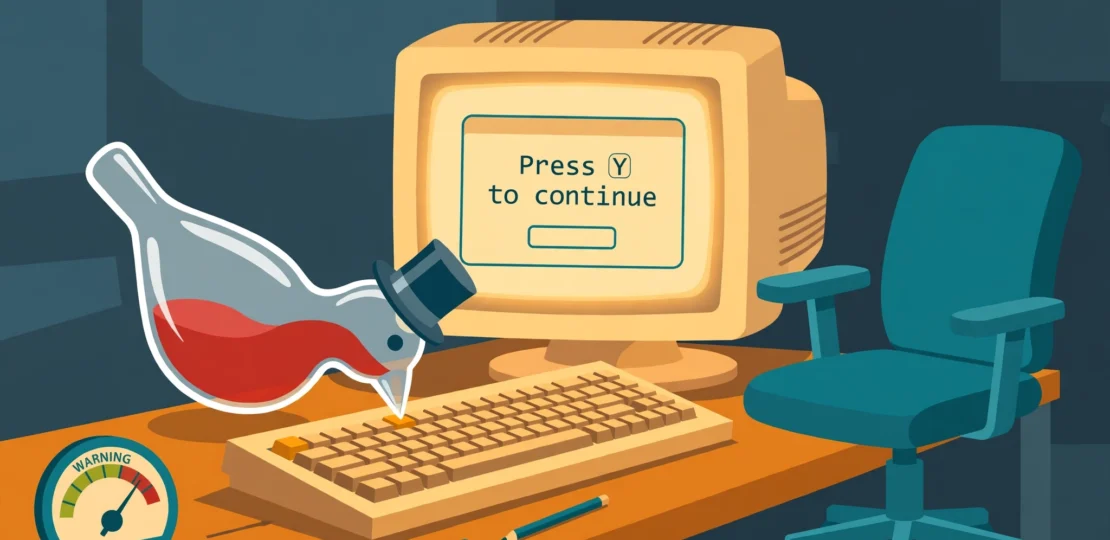
Having eaten his way to disability status so he could work from home, Homer finds that his job mostly comes down to pressing “Y” on a keyboard. He also can’t find the “any” key. So he does what any visionary would do: props a drinking-bird toy in front of the terminal, lets it peck Y on repeat, and heads to the movies.
The bird pecks. The bird tips over. The plant heads for disaster, and Homer has to haul himself back to save it.
Thirty-one years later, we’ve built the bird. It writes code, drafts contracts, summarizes inboxes, and pecks Y faster than Homer ever dreamed.
There’s just one catch Homer never had to deal with.
Our bird has office hours.
The Bird Has Office Hours Now
If you use AI for actual work, you know the banner. Usage limit reached. Resets in… some number of hours you will now spend doing math about.
This March, Anthropic started making Claude’s five-hour session limits burn faster during weekday peak hours — 5 to 11 a.m. Pacific — to “manage growing demand.”2 Weekly limits stayed put. The workday didn’t.
By April, Business Insider was reporting on people restructuring their lives around the reset clock.3 One startup cofounder described working around an invisible meter — and planning meals around reset times. The headline said it all: Saturdays are for Claude.
Why does the bird have a time card? Because demand for AI compute is outrunning the chips, power and data centers that serve it. As one researcher put it to Scientific American, ten times the users using it ten times as hard means roughly a hundred times the compute.4 Nobody has a hundred times the compute lying around.
So the providers ration. And we adapt.
I’ve been calling it The Reset Window Economy: a workday organized not around your deadlines, your clients, or your coffee — but around when the machine lets you back in.
And it hands everyone the same little dilemma, several times a week:
Do I just do this by hand? Or do I wait for the bird?
Five Minutes vs. Two Hours Is a Rigged Fight
The math in your head feels obvious. AI does it in five minutes. I’d take two hours. Wait for the reset.
Except that’s not the real fight. The real scorecard looks like this:
- Wait — until the window reopens
- Run — the bird does its thing
- Review — you check the bird’s work
- Fix — you clean up after the bird
Versus: you do it, and you understand every inch of it when you’re done.
Here’s where it gets interesting. We are terrible at scoring this fight.
In 2025, METR ran a randomized trial with 16 experienced open-source developers working 246 real tasks in codebases they knew cold.5 Going in, they predicted AI would make them 24% faster. With AI, they were 19% slower. And afterward — after the stopwatch had spoken — they still believed AI had sped them up by about 20%.
Where did the time go? Prompting. Reviewing. Waiting. Sitting idle. They accepted less than 44% of what the AI generated.
That was early-2025 tooling, and the models have moved since. Fair. But the tools weren’t the interesting finding. The feeling was: people can’t tell when the bird is slowing them down.
That’s the number to keep in your pocket every time you’re tempted to wait five hours to “save” two.
Drinking Bird Review
The standard answer: “I’ll let the AI do it and just review the work.”
Lovely. What does “review” mean?
If the output is easy to check — a list against a spreadsheet, a formula you can recompute, tests that pass or fail — review is cheap, fast, and real. Queue it up. Go to the movies.
If the only way to check the work is to understand it as deeply as if you’d done it yourself, you’re not saving time. You’re doing the job twice, once through someone else’s eyes.
And if you can’t check it at all?
That’s Drinking Bird Review. Peck Y. Peck Y. Peck Y. Everything looks approved right up until the gauge in the corner goes red.
Homer’s bird didn’t fail because it was a bad bird. It pecked Y exactly as designed. It failed because Y was the only answer it had, and nobody was watching the screen when the question changed.
That’s the part of AI-assisted work that gets left off the productivity slide. The bird is very fast.
It’s also very agreeable.
“I Can Still Do the Work of One Person”
There’s a counterargument, and it deserves the floor.
Comb through Hacker News outage threads and you’ll find developers joking about coding “like a caveman” every time Claude goes down. One commenter, ramesh31, cut through the jokes: he can still do the work of one person by hand — “but that’s not acceptable anymore.”6
That’s the strongest case for waiting. People didn’t forget how. The bar moved. When the person at the next desk ships at bird speed, “I did it manually” stops sounding like craftsmanship and starts sounding like an excuse. For a founder, hours are the scarcest line on the balance sheet. Burning two of them to prove you still can is pride in a work apron.
So yes — sometimes waiting is the right call. Often, even.
But watch what happens over time. Every wait makes the manual muscle a little softer. A softer muscle makes manual slower. Slower manual makes waiting look smarter. Round and round. METR reportedly struggled to re-run its study in 2026 because developers didn’t want to work without AI at all.6 Not couldn’t. Wouldn’t.
That’s a ratchet. And ratchets have owners.
Whoever runs the reset clock decides when your workday starts, which hours count as peak, and — eventually — what the fast lane costs. We’ve covered on this site where the money for all that compute is coming from.7 The meter isn’t a bug in the business model. The meter is the business model.
Is waiting for the bird smart time management, or slow-motion dependency? Both. Usually on the same afternoon.
Queue It or Grab It
So when the banner drops, what do you actually do?
You sort. Two piles.
Queue it
When the task is repeatable, the output is easy to check, and you’ve got something better to do with the wait. Boilerplate. Formatting. First drafts you’ll rewrite anyway. Summaries you can verify against the source.
Grab it
When it’s a judgment call, when checking costs as much as doing, when the deadline beats the reset, or when it’s a skill you’d hate to lose. Pricing. The angry-client email. Anything that needs your fingerprints on it.
Split down the middle? Do the thinking yourself. Queue the typing.
(The Gold Root Solutions version of this piece turns it into a six-question checklist for small-business owners, if you want the practical take.)8
The piles matter less than having them before the banner shows up — instead of burning forty-five minutes of a five-hour wait deciding what to do with the five-hour wait.
Because that’s the real waste. Not the hand-work. Not the reset window. The dead air in between, where you’re neither working nor resting, just refreshing the usage page like it owes you money.
Somebody Watch the Gauge
Here’s the thing about Homer: the bird wasn’t the mistake.
Honestly, the movie wasn’t either. Letting the machine run while you do something else is the whole point of having a machine.
The near-meltdown came from the combination — a bird that could only say yes, a screen nobody was reading, and a guy who assumed pressing Y was the same thing as doing the job.
Thirty-one years later, we’ve got a much smarter bird, a meter on its beak, and a brand-new national pastime: waiting for it to wake up.
Go ahead. Queue the work. Catch the matinee.
Just make sure somebody’s watching the gauge.