


The Money Already Moved
September 19, 2026 | by Adrian Gauna
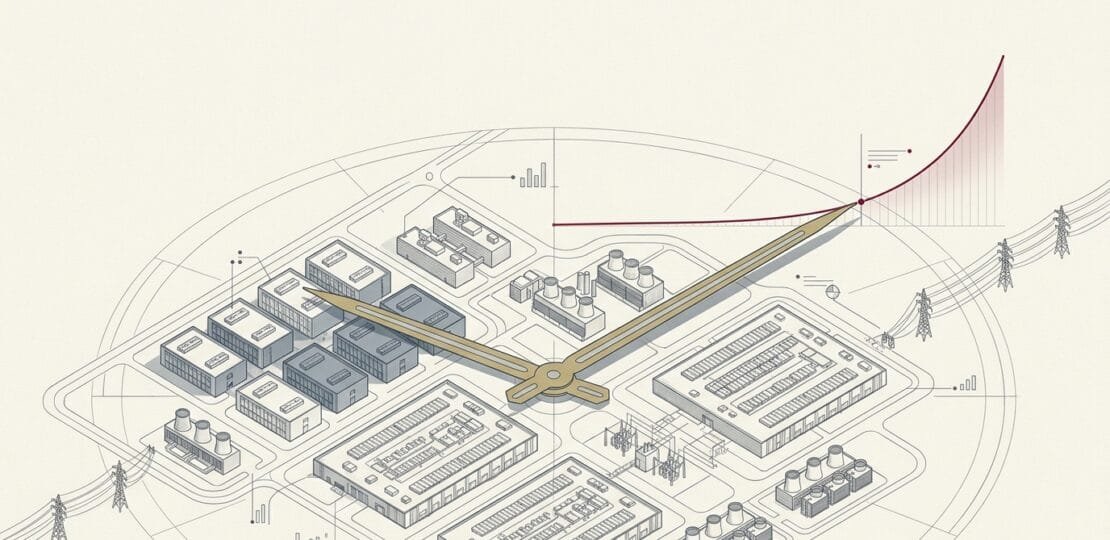
Since July the credit market has priced one specific risk — and it isn’t whether AI works.

TheFeedLab.io · Investigation
The Money
Already Moved
Since July the credit market has priced one specific risk — and it isn’t whether AI works.
My AI wanted an epic cinematic montage. Something climactic and vertigo‑inducing to express the state of AI: a mountaineer almost out of oxygen near the peak, hand shaking toward the summit. Or a personal and intimate one: a house with a mortgage attached, the family inside unaware. Then a restaurant tab climbing while the table argues about whether the food is any good.
Everyone is already at maximum alarm about AI. The bubble talk is ambient, the doom is priced into the vibe if not the market, and a good metaphor right now just gets filed with everything the reader has already decided to feel.
What’s been sitting on the record since July isn’t cinematic. It’s narrow, contractual, and boring in the way that actually costs people money — and almost nobody has processed what it says.
Part IJuly 28: When Growth Wasn’t Enough
CoreWeave’s five‑year credit default swap spread moved above 850 basis points, according to contemporaneous market reporting. The next day the stock fell 9% to $61.53, Nebius dropped 10%, and Oracle slipped 2% — with Nebius down 43% over the prior month and CoreWeave down 36%.1
The trigger was the credit market, not earnings.
At that level, using the conventional 40% recovery assumption, the spread implied an annual hazard rate near 14% — roughly a 50% cumulative five‑year market‑implied default probability.✦ It is a price for risk, not a prediction.
It was also an extraordinary price to attach to the company reporting these numbers the same month. CoreWeave posted $2.575 billion in second‑quarter revenue, up 112.3% year over year, and $103.7 billion of remaining performance obligations, with Meta, OpenAI and Microsoft among its anchor customers.8
A company growing revenue 112%, with contracted obligations from three of the most creditworthy customers in technology. And the bond market priced its debt near coin‑flip odds.
That is not a market saying this business doesn’t work.
Oracle tells the same story from the opposite end of the credit spectrum. Its five‑year CDS reached 198.23 basis points on July 17, edging past the previous record of 198.18 set in late March, and touched 212 basis points later that month — about $212,000 a year to insure $10 million of Oracle debt.23 For scale: Oracle near 200 basis points against roughly 78 for Nvidia, 93 for Meta and an investment‑grade CDS index near 53.4
Oracle is not a distressed company. Oracle is a company with an enormous OpenAI commitment and a construction schedule.
The instruments themselves have become a growth business. AI companies and tech stocks accounted for nearly $650 million of second‑quarter corporate CDS trading according to DTCC data — up 20% on the first quarter and almost 600% year over year.5
Part IIThe Sentence That Explains the Trade
On September 16, Reuters reported monthly positioning data from Hazeltree, which tracks short books across a client base of more than 700 funds. Buried in the summary was the most useful sentence written about AI markets this year.
Explaining why funds were selling AI‑linked names, Hazeltree said the selling appears to reflect the funding question rather than a view on the underlying business’s strength.6
Not a short seller talking his book. Not a permabear with a newsletter. A positioning‑data provider describing what its clients are doing, in the flattest language available.
The trade isn’t against AI. The trade is against the cost of finishing AI.
Those are different bets with different consequences, and nearly every version of this story collapses them into one.
Part IIIWhat the Short Book Shows, and What It Doesn’t
In July, hedge funds increased short positions in Super Micro Computer, CoreWeave and Nebius Group. All three were in the top 10 most‑shorted stocks that month, and all three had been top 10 in June, with each position growing.7 Straightforward: funds got more bearish on the leveraged operators as the credit repricing hit.
In August the short book broadened. Super Micro, CoreWeave, Nebius and GE Vernova — which supplies data centers — all remained among the most‑shorted, while funds cut some of their AI bets overall. Alphabet lost its place among Hazeltree’s most concentrated long positions as the number of funds shorting it exceeded those holding it long for the first time this year.6
I’m not going to tell you that proves a funding trade. Short interest is a weather map, not a microscope. Positions get taken for relative‑value hedging, factor exposure, valuation, regulatory risk, ad‑cycle risk, or plain churn, and Alphabet has candidates in every one of those columns.
What it does show is that AI skepticism stopped fitting inside one tidy bubble label.
The credit market is cleaner. CDS spreads and financing costs don’t tell you what a hedge fund thinks about Google’s capex. They tell you what lenders charge the companies that have to keep building.
Part IVThe Math Does Not Need My Help
CoreWeave’s quarterly filing for the period ended June 30, 2026. The company’s own numbers.8
| Line item | Figure |
|---|---|
| Principal debt obligations | $35,551M |
| Interest expense, six months | $985M |
| Net interest expense, Q2 | $640M |
| Operating income, Q2 / H1 | −$49M / −$193M |
| Total assets | $77.1B |
| Property & equipment | $46.7B |
| Remaining performance obligations | $103.7B |
| Operating cash, H1 | $3.663B |
| Purchases of property & equipment, H1 | $14.117B |
| Net debt issued / repaid, H1 | $16.747B / $5.219B |
| 2026 guidance — revenue | $12.4–13.2B |
| 2026 guidance — capital expenditure | $35–39B |
CoreWeave, Inc., Form 10‑Q, quarter ended June 30, 2026.
Second‑quarter net interest expense of $640 million is nearly 25% of revenue, and more than five times adjusted operating income. Several delayed‑draw facilities carried effective interest rates of 9% to 15% at quarter‑end. At the guidance midpoints, capex runs 2.9 times revenue.
Customer concentration matters for how those contracts behave under stress. In the first half, Customer A accounted for 40% of revenue and Customer B for 23%, and as of June 30 each comprised 32% of accounts receivable.8 Fitch attributed roughly 65% of first‑quarter revenue to the top two customers. The Financial Times reported that on one major loan facility, the single largest counterparty is Anthropic at roughly 40%, followed by the trading firm Jane Street at about 35%, with Midjourney, Hudson River Trading and Anysphere making up the remainder.9
Anthropic is among the best‑funded labs in the field. It is also privately held with no public credit rating. That doesn’t make its credit risk unknowable — lenders price private borrowers constantly, on financials, covenants, collateral and sponsor strength. It does mean outside investors have less standardised information than they would with a rated public counterparty.
None of that describes a company that can’t sell its product. All of it describes a company whose plan requires continuous access to capital markets on terms it does not control.
The $51.6 billion figure circulating online is not CoreWeave’s principal debt. It folds debt together with lease obligations and other liabilities. The filing says $35.6 billion. Whoever’s circulating the bigger number doesn’t need it.
Part VWhen the Buildout Prices Itself Out
At a sufficiently high cost of capital, the buildout doesn’t need demand to disappear. It slows because the next increment of capacity no longer clears its financing cost. The buildout self‑throttles.
That also explains why credit and equity have been telling different stories all year.
Equity prices the destination.
Credit prices the trip.
Oracle, the largest non‑financial borrower in the Bloomberg U.S. high‑grade index, saw its CDS climb above 215 basis points with its 2054 notes yielding 7.8%.1 The revenue forecast didn’t change. The cost of getting there did.
The exposure isn’t uniform, and the difference is instructive. CoreWeave and the leveraged neocloud complex rely heavily on debt, leases and project finance to fund capacity built around short‑cycle hardware. Oracle enters the same capital‑intensive buildout from a far stronger corporate balance sheet — and its widening CDS shows that even an investment‑grade incumbent isn’t immune to the cost of financing it.
Part VISame Demand. Different Funding Structure.
If the market were making a simple sector call — that AI infrastructure is a bad business — funding structure would matter less than it does. It doesn’t.
Nebius operates in the same AI‑infrastructure buildout, faces the same broad GPU‑obsolescence risk, and sells into the same demand wave. Its funding structure is different.
It posted $582.3 million in second‑quarter revenue, up 454%, with a $37.5 billion RPO and a $27 billion Meta agreement. It covers 50–60% of landmark deal capex with customer prepayments, expects more than $9 billion of such inflows in 2026, and holds $8 billion of cash against roughly $10 billion of total obligations. Second‑quarter operating cash flow was $2.3 billion, and those prepayments materially reduce its need for external funding.10
On a rate‑hike scenario, the neocloud with less debt, more cash and prepayments doing the heavy lifting screens more defensively. That’s Nebius.
Two companies serving the same buildout. Two radically different funding structures. The comparison isolates the variable investors are being forced to price first.
Part VIIThe Screen Everything Is Reading
On July 29, the day after CoreWeave’s spread blew out, the 10‑year Treasury yielded 4.65% — the 98th percentile of its trailing twelve‑month range.1 By the second week of September it had reached 4.80%, the high of the past year, with the federal funds upper bound at 3.75% and futures beginning to price renewed hike odds.10
CoreWeave completed a syndicated term loan during what management itself called one of the most dislocated weeks for credit this year. If yields keep rising, refinancing that stack gets more expensive fast.
Everything above is downstream of one line on a screen.
Part VIIIWhat the Market Is Actually Pricing
Credit markets began repricing this risk in July — publicly, daily, and with far more specificity than the broad AI debate has managed.
What they’re pricing is narrow and unglamorous: that the money required to finish the AI buildout costs more than the contracts assumed when they were signed. Not that the technology fails. Not that demand evaporates. Not that the data centers go dark.
That the financing gets expensive, and the companies whose model depends on cheap continuous capital find out what that means.
None of this is hidden. The positioning data publishes monthly. The CDS spreads print daily. The 10‑Q is a free download.
It’s fucked in a specific way, and the specificity is the point. Not the civilizational panic, not the jobs apocalypse, not the bubble‑bursting fantasy everyone’s rehearsing. A financing problem — which is real, which has broken real things before, and which is survivable in ways the apocalypse is not. Nebius shows what a more defensively financed version of the same buildout looks like.
A company grew revenue 112%, carried more than $100 billion in remaining performance obligations, and watched its five‑year CDS trade near coin‑flip default odds.
Everyone I saw discussing it wanted to argue about whether AI is real.
The bond market had already stopped asking.
✦ A common approximation divides the CDS spread by one minus the assumed recovery rate to estimate an implied annual hazard rate. At 855 basis points and a 40% recovery assumption that produces roughly 14.25% annually — about a 50% cumulative five‑year market‑implied default probability under a constant‑hazard assumption. Changing the recovery assumption moves the result materially; the figure is a market price for risk, not a forecast of outcomes. ↩
Sources
- 1Contemporaneous market reporting on the July 28–29 session, incl. 24/7 Wall St., “Nebius Drops 10%, CoreWeave Sinks 9% as Rising Credit‑Swap Costs Hit the AI Cloud Trade” (Jul 29, 2026). Secondary; CDS level attributed to Bloomberg data. 247wallst.com
- 2Briefs.co, “Oracle Debt Protection Costs Hit Record Peak on AI Spending” (Jul 17, 2026). briefs.co
- 3CryptoBriefing, “Cost of insuring against default by AI hyperscalers hits record levels” (Aug 12, 2026). cryptobriefing.com
- 4Reuters / S&P Global Market Intelligence, “Oracle Stock Drops 2.3% as Default Insurance Hits 200 Basis Points” (Jul 29, 2026). finance.yahoo.com
- 5DTCC second‑quarter corporate CDS trading data, reported Jul 30, 2026. protos.com
- 6Reuters, “Hedge funds step up bets against consumer stocks in August, Hazeltree says” (Sep 16, 2026). theglobeandmail.com
- 7Reuters, “Hedge funds upped short AI bets in July, Hazeltree says” (Aug 12, 2026). finance.yahoo.com
- 8CoreWeave, Inc., Form 10‑Q for the quarter ended June 30, 2026, U.S. Securities and Exchange Commission. sec.gov
- 9Financial Times reporting on CoreWeave loan counterparty composition, and Fitch Ratings on first‑quarter customer concentration, as summarised in MarketWise, “AI Infrastructure Stocks: What CoreWeave’s Debt Reveals” (Aug 2026). marketwise.com
- 10Nebius funding-structure figures and prevailing rate conditions as reported in 24/7 Wall St. (Sep 10, 2026). Secondary; company figures to be confirmed against Nebius Q2 2026 disclosure and rates against U.S. Treasury daily par yield data. 247wallst.com
RELATED POSTS
View all


How Inventors Conquer Patents & Prototypes Without Breaking
October 8, 2025 | by OLI IDEA

The Owl in the Coalmine: AI’s Energy Waste, Debt‑Fueled Buildout, and Private Credit Stress
February 20, 2026 | by Adrian Gauna

Three Commons: Nobody built the agents a message board. They kept finding one.
September 18, 2026 | by Adrian Gauna